Annual Service & Tune-Up
Combustion analysis, pressure verification, expansion tank test, low-water cutoff test, circulator inspection, and full system bleed. Once a year keeps your boiler running reliably.
Boiler heat is some of the most comfortable, even warmth a home can have — when the system is maintained. We service, repair, and replace residential boilers across Colorado, including high-efficiency condensing boilers and complete hydronic heating systems.
A well-maintained residential boiler can outlast two or three forced-air furnaces — typically 20-30 years for a modern unit and 30-50 years for older cast iron boilers. The catch is that "well-maintained" isn't optional. Boilers run constantly through Colorado winters, push hot water through hundreds of feet of piping, and depend on a network of pumps, valves, expansion tanks, and controls all working together. Neglect any one of them and the failure cascades.
Our annual boiler service visit is designed to catch the small stuff — a tired circulator, a sticking zone valve, a low-water cutoff that hasn't been tested — before it becomes a no-heat emergency in February.
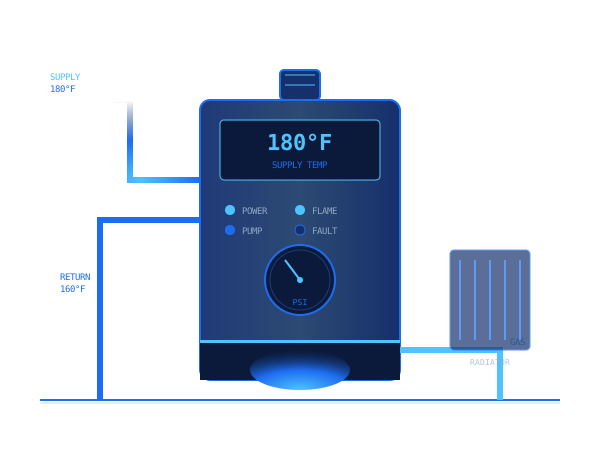
From annual tune-ups to full high-efficiency replacements, we service every type of residential boiler across the Front Range.
Combustion analysis, pressure verification, expansion tank test, low-water cutoff test, circulator inspection, and full system bleed. Once a year keeps your boiler running reliably.
No heat, low pressure, leaking relief valve, ignition lockouts, weird noises, uneven heat between zones — we troubleshoot and repair every common boiler issue.
Old cast iron unit on its last winter? We install modern high-efficiency condensing boilers from Weil-McLain, Burnham, Lochinvar, Triangle Tube, and Navien — up to 95%+ AFUE.
The pump that moves hot water through your home is the most common wear item. We replace failing circulators with quiet, efficient ECM models that cut electricity use significantly.
Multi-zone systems rely on zone valves and a smart control panel. When one zone won't heat, the cause is usually here — and usually fixable in under an hour.
Pressure problems almost always trace back to a waterlogged expansion tank or failing relief valve. Quick to diagnose, inexpensive to fix early.
Mineral buildup, sludge, and corrosion products restrict flow and damage components. Annual chemical cleaning keeps the system efficient and protects the boiler.
Service, repair, and new installation of radiant floor heating systems. Manifold work, leak repair, zoning upgrades, and new construction rough-in.
Bleeding air from radiators, replacing damaged baseboards, balancing zones for even heat, and integrating new radiation when you remodel.
If your home was built before the mid-1990s, your boiler is almost certainly a standard 80-85% AFUE unit — meaning 15-20% of the fuel you pay for goes up the chimney. Modern high-efficiency condensing boilers achieve 90-98% AFUE by capturing heat from exhaust gases that older boilers waste.
A condensing boiler has a secondary heat exchanger that pulls additional heat out of the exhaust before it leaves the home. The water vapor in the exhaust condenses into liquid (which is where the name comes from), giving up its latent heat to the heating water. The cooled exhaust is then vented through PVC pipe — no chimney required.
A new residential boiler installation in Colorado typically runs $6,000-$15,000 fully installed:
Right-sizing matters more than picking the most expensive unit. An oversized boiler short-cycles, wears out faster, and costs more to run. We perform a heat-loss calculation to size the new unit to your actual home — not to the inflated BTU rating of the old boiler that was almost certainly oversized when it was installed.
In a Colorado winter, a dead boiler isn't something to wait on. Call 303-253-7246 any hour — we keep parts for common boiler repairs on the truck and can usually have your heat back the same visit.
Boilers and furnaces both heat homes, but they work very differently:
Many Colorado homes built before 1970 have boilers — and many homeowners replace them with new boilers because the comfort difference is significant. We can help you evaluate whether sticking with hydronic heat or converting makes more sense for your home.
We provide boiler service, repair, and installation across the Colorado Front Range, including:
Denver Metro: Denver, Aurora, Lakewood, Westminster, Thornton, Arvada, Wheat Ridge, Englewood, Littleton, Commerce City, Broomfield, Northglenn, Centennial, Highlands Ranch, Parker, Castle Rock, Greenwood Village, Cherry Hills Village.
Boulder & North: Boulder, Longmont, Louisville, Lafayette, Erie, Superior.
Colorado Springs Metro: Colorado Springs, Monument, Castle Pines.
A new residential boiler typically costs $6,000-$15,000 fully installed. Standard cast-iron boilers run $5,000-$8,000; high-efficiency condensing boilers run $8,000-$15,000. We provide free quotes after a site assessment.
A well-maintained residential boiler typically lasts 20-30 years. Cast iron boilers can last 30-50 years. High-efficiency condensing boilers average 15-20 years. Annual service is essential.
A condensing boiler captures heat from exhaust gases that traditional boilers waste, achieving 90-98% AFUE compared to 80-85% for standard boilers. They use PVC venting and typically save 15-25% on heating bills.
Kettling means scale buildup; banging usually indicates air in the system; whistling can be a circulator issue; gurgling typically means low pressure or air in radiators. Most are diagnosable and repairable.
Consider replacement if your boiler is over 20 years old, repair costs exceed 50% of replacement cost, your heating bills are rising, or you're having repeated breakdowns.
A boiler heats water that circulates through radiators or radiant floors (hydronic heat). A furnace heats air distributed through ducts. Boiler heat is more even and comfortable; furnaces are cheaper to install but use ductwork.
Yes — 24/7 emergency boiler repair across Colorado. We carry common boiler parts on the truck and can usually diagnose and repair common failures on the first visit.
Once a year, ideally in the late summer or early fall before heating season. Annual service catches small problems before they become emergencies and protects manufacturer warranty terms.
Either way, we'll inspect the system honestly and tell you what it needs — and what it doesn't.