Trenchless Sewer Repair: The Complete Guide for Colorado Homeowners
Twenty years ago, fixing a broken sewer line meant excavating a deep trench across your yard, often through the driveway and sidewalk, with weeks of cleanup afterward. Today, trenchless sewer repair can solve most of the same problems with minimal digging — usually just two small access pits at the start and end of the line.
What Is Trenchless Sewer Repair?
Trenchless sewer repair is a family of methods for repairing or replacing sewer lines without traditional open-trench excavation. The two primary techniques are:
- CIPP Lining (Cured-In-Place Pipe): A flexible liner saturated with epoxy resin is pulled through the existing pipe, inflated against the inner walls, and cured (heat or UV) to form a new structural pipe inside the old one. The result is a seamless, jointless pipe with a 50-year warranty.
- Pipe Bursting: A bursting head is pulled through the existing pipe while a new HDPE pipe is towed in behind it. The old pipe fractures outward into the surrounding soil while the new pipe takes its place. Best when the existing pipe is too damaged to line.
Trenchless Sewer Repair Cost in Colorado
Trenchless sewer repair costs in Colorado typically range from $4,000 to $20,000, depending on:
- Length of line being repaired — most residential sewer lines from house to street are 40-80 feet
- Depth of the line — deeper lines require deeper access pits
- Method chosen — CIPP lining is typically less expensive than pipe bursting
- Site access and obstacles — landscaping, driveway crossings, and underground utilities affect labor
- Permit and inspection requirements — vary by jurisdiction
While trenchless costs more per linear foot than excavation, total project costs are often comparable or lower once you factor in landscape restoration, concrete replacement, and lost-time costs from full excavation.
Trenchless vs Traditional Sewer Replacement
Choose trenchless when:
- You have a finished landscaping, sidewalk, or driveway you don't want to destroy
- The line is structurally intact enough to host a liner (we'll confirm with the camera)
- You want minimal site disruption and faster completion
- You want a 50-100 year warranty on the new pipe
Excavation may be necessary when:
- The pipe has fully collapsed and won't accept a liner or burst head
- The line has severe bellying (sagging) that needs to be re-graded
- The line needs to be re-routed entirely
- You need to add cleanouts or other access points
Sewer Camera Inspections: What They Find, What They Cost
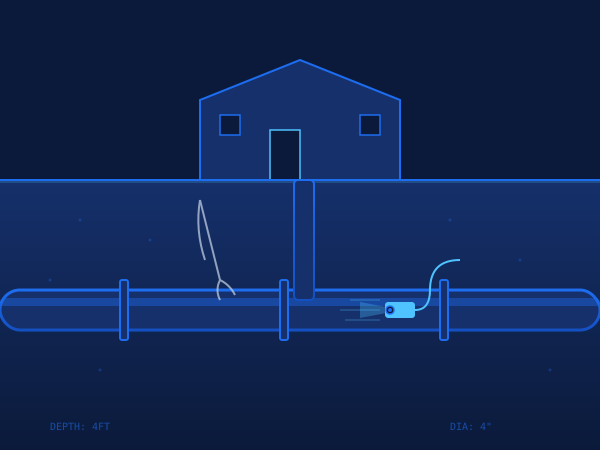
A sewer camera inspection (also called a sewer scope) sends a high-resolution waterproof camera through your sewer line on a flexible push-cable, recording video as it travels. The technician watches a live feed and notes the location and severity of any issues found.
What Sewer Camera Inspections Reveal
- Tree root intrusion — invading through joints or cracks
- Cracks, holes, and offset joints — early signs of failure
- Bellies (low spots) — where solids settle and cause recurring clogs
- Pipe deterioration — corrosion in cast iron, scale buildup, mineral deposits
- Foreign objects — anything that's been flushed and shouldn't have been
- Pipe material identification — Orangeburg, clay, cast iron, ABS, PVC
- Connection issues — where laterals meet the main, vent issues, improperly installed cleanouts
When You Should Get a Sewer Camera Inspection
- Before buying a home, especially homes built before 1980 or with mature trees on the lot
- After repeated drain cleanings in the same line — a sign something deeper is wrong
- If you're planning landscaping or hardscaping over your sewer line
- If you're seeing warning signs: multiple slow drains, gurgling toilets, sewer odors, wet spots in the yard
- Every 5-7 years as preventive maintenance for older homes with clay or cast iron sewer lines
Why a Pre-Purchase Sewer Scope Is Worth Every Dollar
A sewer line repair after closing can cost $10,000-$25,000. A pre-purchase sewer camera inspection costs $150-$300. We've seen homebuyers negotiate tens of thousands in repair credits or walk away from bad deals because of what our camera found. Schedule a real estate sewer scope.
Warning Signs Your Sewer Line Needs Attention
Sewer trouble usually develops slowly. By the time you have a backup, the underlying issue has been brewing for months or years. Catch the early signs:
- Multiple slow drains — when sinks, showers, and toilets are all sluggish, the issue is downstream of all of them
- Gurgling toilets — air trapped in the sewer line escaping through the closest fixture
- Sewer odors indoors or in the yard — a sign of a break, leak, or compromised vent
- Wet patches or unusually green grass over the path of your sewer line — leaking sewage fertilizes the surface
- Backups in lowest drains first (basement floor drain, ground-level shower) when other water is being used
- Sinkholes or settling pavement over the sewer route — a serious sign of an active pipe failure
- Recurring clogs in the same line, even after professional cleaning
- Sewage backing up into the home through any drain — a true emergency
Common Causes of Sewer Line Failure in Colorado
Colorado's combination of expansive clay soil, freeze-thaw cycles, mature trees, and homes ranging from 1900s clay pipes to modern PVC creates a unique mix of sewer issues. The most common causes we see:
- Tree root intrusion — the #1 cause of residential sewer problems. Roots seek out the moisture inside pipes through any small crack or joint.
- Aging clay or Orangeburg pipe — homes from the 1920s-1950s often have clay tile sewer lines; some 1950s-1970s homes have Orangeburg (a tar-impregnated paper composite that fails over time).
- Soil shifts and bellying — Colorado's clay soils swell when wet and shrink when dry, causing pipe sags where solids accumulate.
- Cast iron corrosion — mid-century cast iron sewer lines eventually corrode from the inside, building up scale that restricts flow.
- Improper installations — older work that didn't follow modern slope requirements or used incorrect materials.
- Foreign objects — "flushable" wipes, feminine products, paper towels, and grease buildup all combine to form clogs that, over time, can damage pipe walls.
Service Areas Across Colorado
We provide sewer line repair, trenchless repair, and camera inspection across the Colorado Front Range, including:
Denver Metro: Denver, Aurora, Lakewood, Westminster, Thornton, Arvada, Wheat Ridge, Englewood, Littleton, Commerce City, Broomfield, Northglenn, Centennial, Highlands Ranch, Parker, Castle Rock, Greenwood Village, Cherry Hills Village.
Boulder & North: Boulder, Longmont, Louisville, Lafayette, Erie, Superior.
Colorado Springs Metro: Colorado Springs, Monument, Castle Pines.
Active Sewer Backup Right Now?
If sewage is coming up through floor drains or showers, stop running water immediately and call 303-253-7246. We answer 24/7 and can usually be on-site within hours for active backups.
Frequently Asked Questions About Sewer Line Repair
How much does sewer line repair cost in Colorado?
Sewer repair costs range from $250 for a simple drain clearing to $25,000+ for a full excavated replacement. Trenchless repair (CIPP lining) is typically $4,000-$15,000, and pipe bursting is $5,000-$20,000. We always provide a written quote after camera inspection — no surprise charges.
What is trenchless sewer repair?
Trenchless sewer repair is a method for fixing or replacing sewer lines without major excavation. The two main types are CIPP lining (creating a new pipe inside the old one) and pipe bursting (pulling a new pipe through while breaking the old one). Both preserve landscaping and reduce repair time.
How long does trenchless sewer repair last?
Trenchless sewer repairs typically last 50-100 years. CIPP liners come with 50-year manufacturer warranties; pipe bursting installs new HDPE pipe rated for a 100-year service life. This is comparable to or better than traditional excavated replacement.
How do I know if I need sewer line repair?
Common signs include multiple slow drains, gurgling toilets, sewer smells, wet spots in the yard, recurring backups even after drain cleaning, sinkholes, and sewage backing up indoors. A camera inspection confirms whether you have a sewer line problem and what kind.
Should I get a sewer scope before buying a house?
Yes — a pre-purchase sewer camera inspection is highly recommended for any home in Colorado, especially homes built before 1980 or with mature trees. The inspection costs $150-$300 and can reveal problems that would cost tens of thousands to fix after closing.
Can tree roots really damage sewer lines?
Yes — tree roots are the most common cause of sewer line damage in Colorado. Roots seek out moisture and nutrients inside pipes, entering through cracks or joints. Once inside, they grow rapidly, eventually filling the pipe.
How long does a sewer line replacement take?
Trenchless sewer repair takes 1-2 days. Traditional excavation takes 2-5 days depending on length and depth. Most projects include 24-48 hours where water use must be limited.
Do I need a permit for sewer repair in Colorado?
Yes — most Colorado jurisdictions require permits for sewer repair and replacement, including most trenchless work. We pull all required permits and arrange inspections as part of the job.
Is sewer line repair covered by homeowner's insurance?
Sewer line repair is typically not covered by standard homeowner's insurance. Some policies offer "service line coverage" as an add-on for under $50/year, which can cover sewer line repair and replacement. We can provide documentation and footage to help with any claim.